Monday, February 13, 2012

Narrator Spotlight: Davina Porter

I have a few voices in the audiobook world I'll follow around from author to genre, thanks to the excellence of their narration. Davina Porter is one. I first encountered her reading Diana Gabaldon's Outlander series, which, if you haven't read it and you even a little bit like the idea of a time-traveling historical romance set in the Scottish Highlands, go check it out and thank me later. Porter also reads Alexander McCall Smith's Isabel Dalhousie series, which also involves Scotland, but otherwise is an entirely different animal. Isabel is an editor of a moral philosophy journal, and frequently finds herself investigating problems for friends and acquaintances. 

Someone recommended Marion Zimmer Bradley's The Mists of Avalon series. Porter narrates them, so I downloaded the first in the series, The Mistress of Magic. It's been a long time since the romance of the Arthurian legend spoke to my soul, and Morgaine was never my favorite of the bunch. Still, this retelling from her point of view is definitely intriguing in an anthropological-feminist sort of way. Perhaps my expectations were too high, given the solid recommendation and my weakness for whatever Porter chooses to tell me, but I was constantly drifting off during this book. I was frustrated by Morgaine's inability to apply rational thought to her situation, less than moved by the Greater Good type issues of her aunt, and not enchanted by the magical connection between Arthur's parents (her mother and step-father), who may have been fated from centuries of past lives, but aren't very good at noticing the relationships happening in front of them in their present. I'm probably too much of a completest with series (earlier today I read Ally Condie's Crossed, even though I spent half the summer making fun of the audio of Matched with my son and niece as we commuted to and from work.) But I think I'll stop at this point with this particular series.

Far more engaging for me is Nicola Upson's Josephine Tey Mystery series, also, of course, narrated by Porter. I may or may not have mentioned how much I've enjoyed discovering Tey's mysteries over the past year. Since I read them all, though, I was looking at a Tey-less future until I found out about Upson's series, in which she brings Tey to life as the heroine of her own detective stories. Tey teams up with her friend, Scotland Yard Inspector Archie Penrose, to suss out murderers in their world. Tey is Scottish, which suits Porter's voice so well, but Porter also accents all of the English voices beautifully, giving Penrose in particular a strong charm that enhances the difficult relationship between the friends.


The first novel, An Expert in Murder, is set in London's West End, where Tey's first successful play is ready to close, with murder in the wings. Tey is struggling with the changes in her life that the play's popularity has brought her, but her private issues don't stop her from diving into the investigation, to Penrose's mingled dismay and gratitude. Things between them are at an uneasy truce by the end of Upson's first novel, and as Angel with Two Faces opens, both are hoping that a holiday in Cornwall (Penrose's childhood home) will give them a chance to clear the air. Unfortunately, a murder right off the bat gets in the way, and Penrose is left walking a delicate line between local boy come home and Inspector in the midst. (There is a bit of a Lady in the Lake overtone to this novel, so all of that Avalon stuff was a good refresher, at least.) I thoroughly enjoyed Upson's twists and turns in this one, especially, and felt like I could walk into the village and name at least every third inhabitant by the end. I'm so looking forward to reading more by Upson, and have just downloaded the third in the series, which came out a week ago.

Saturday, February 11, 2012

Two Minervas You Should Meet

Without particularly meaning to, I listened to two books with excellent protagonists named Minerva, who go by Min (not Minnie), with unruly hair and strong voices and romantic problems. Other than that, they're not a lot the same story, but both are told so well.

In Why We Broke Up, written by Daniel Handler and illustrated by Maria Kalman, Min Green is a 16 year old with a broken heart. She was never one of the popular girls, but got along well with her don't-call-them-artsy friends. Then she and Ed, the star of the basketball team, got together. Their relationship was intense and charming and doomed. The novel is the letter that Min writes Ed to accompany the box of memorabilia that Min hoarded over the course of their relationship. Each section is a story that relates to the objects that Kalman illustrates.

Min's voice is so lovely and true. Maybe she's a little emotionally prescient, but she has all of the passion and obsession with minutia and Grand Romance that makes this novel a success. Ed is a pretty amazing character, too, at least as seen through Min's eyes. How much of the generous, compassionate, sensitive soul yearning to break free from the constraints of his popular, charming jock persona is truly him as opposed to what Min invests in him remains to be seen. But in my imagination, Ed actually reads - and reflects on - the box of memories and the accompanying letter, and some day he breaks free of those chains of his own accord. Min is given a perfect blend of earnestness, heartbreak, naivete, and intelligence by narrator Khristine Hvam. The audiobook includes a PDF of Kalman's charming illustrations, which you need to get the full impact of the text.

My other Minerva is Min Dobbs, heroine of Jennifer Crusie's Bet Me. This novel opens with Min being dumped, though she is less devastated by it than Min Green was. Of course, the jerk who dumped her, David, hasn't got the redeeming features of Handler's Ed. Then again, it doesn't look like Cal has a lot of redeeming features of his own. Still, when Min overhears a bitter David betting a skeptical Cal that he can't get Min to sleep with him, she decides to spite David by accepting Cal's dinner invitation. The fact that Cal only meant the bet to be for a meal provides most of the misunderstandings between them for the next month, but David and Cal's ex also do what they can to drive a wedge between the two.

Min has issues with her weight - her mother is, among other things, terrified that she'll make little sister Diana's wedding look bad because Min is too fat. Cal has issues with his emotional intelligence - struggling with dyslexia as a child in a successful family means being perceived as stupid is a hot button for him. And although Min and Cal find plenty of other reasons to push each other away and ignore the rightness they feel when they are together, they each see immediately through the biggest issues. Jumping to each other's defense, and helping each other reframe their issues in a positive light, they get under each other's skin. It's very Cinderella for both of them, and very charming and sweet and thought-provoking, to boot. Narrator Deanna Hurst is always a great bet for contemporary romance - she is light and clear and you can hear the smile in her voice.

Friday, February 3, 2012

Memory Lane

Over lunch yesterday my sister and I got to talking about our earliest memories. We moved from our house at 1722 Corral Drive (the address will never leave my memory banks!) when I was 7 and she was 6, so we know all the memories from there are our earliest. She has the layout of the upstairs fixed in her memory, as do I, but I also have clear images of most of the downstairs and back yard.

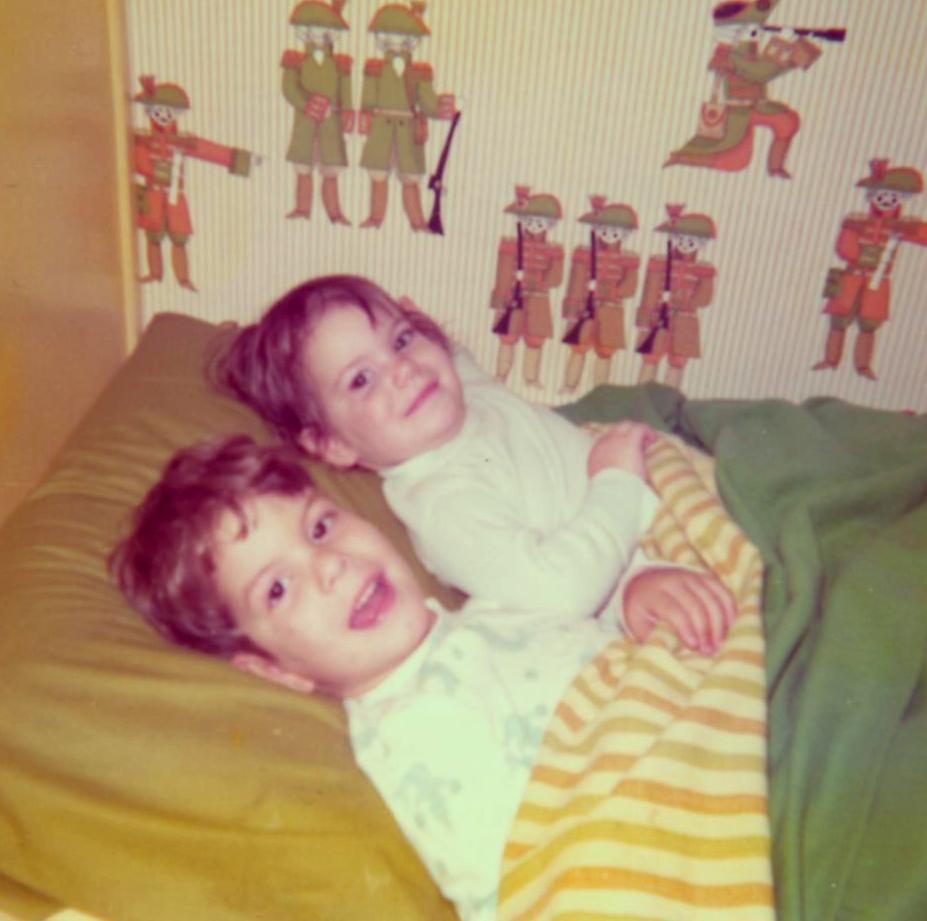
Here's me at almost 2, sharing my big brother's bed. I don't remember sleeping in that room (despite the EXTREMELY AWESOME wallpaper), but have plenty of mental images of the room my sister and I shared. The first wallpaper was green with fluffy bunnies everywhere, and later it was all Old English-type roses, which I'd stare at for hours picking out shapes in the patterns.

I remember standing in the den peering over the edge of my baby brother's bassinet. I was almost 3 when he was born, so I know this has to be among my earliest memories. The bassinet was in the den, which had wood paneling and some truly memorable gold sofas (here they are on Christmas when I was in 3rd grade. I'm the one delighted by my Cinderella doll and my first sewing machine. Check out big brother's Star Wars figures - my sons have those now.) On the other side of the half-wall was the room with the pool table, which had a mirrored ceiling. This made it easier for the four little kids to watch what was happening when the grown-ups played pool. It also left me with some memories of jokes from my parents' friends that I had to sort out when I was much older.

Our dining room, with the blue flocked wallpaper and built-in intercom / radio, I barely remember. We didn't eat in there much. (This is my 4th birthday. Do you love my red robe? I loved my red robe.) The birthday itself I don't remember - the first birthday party I remember was my 6th or so. Try as I might, there are few specific events I remember before starting elementary school. Sis and I both vividly recall traumatic scenes from first grade - I barely made it to the trash can to throw up because I was afraid to ask to go to the restroom, and she got yelled at for littering in the classroom. We remember playground scenes, and walking to and from school, and the time it snowed and we had hot cocoa in front of the fireplace. (Houston: not much of a snow town.)

So I was curious what my boys remembered. They're a lot closer to their earliest memories, after all. D remembers a bit about the townhouse we lived in until he was 2 1/4. He remembers wanting to go up the stairs, but being blocked by the baby gate. Since our house after that had no stairs, I know this is a true early memory. He also has a strong recollection of the dump truck-load of dirt that we had in our driveway when he was 2 1/2 and we'd just moved to our current home. He really, really, really liked that pile of dirt.

There are other early memories he shared with me. His preschool class (and apparently I was prone to giving Lectures About Life even when he was 3.) (But hey, he doesn't judge people based on skin color, so they worked?) He recalls a good bit about a trip to Hawaii with my extended family when he was 3 3/4. He remembers - I love this - coming to the hospital at 4 1/4 to meet his baby brother for the first time, and thinking that he didn't know K would be so cute. He doesn't remember my giant pregnant belly, but does remember being an only child, and knowing that he had a sibling on the way.

K remembers the house I grew up in (not on Corral Drive, the one we lived in after that.) My parents moved from it before he turned three, so the fact that he can describe "the round room with the white chairs and blue carpet and glass table" is clearly a very early memory for him. (He's 1 in this photo with his brother and cousins. How cute are they all, seriously?) K also remembers going on an expedition to buy sheets for his Big Kid Bed. He moved from our bed to his own room when he was about 2 1/2, so the sheets would have been bought around then.

Like his brother, his more detailed early memories are around 4 years old. My parents took everyone to Alaska when he was 4 1/2 and he can tell me a ton about that trip. A year before that the four of us road tripped to Colorado, but that doesn't really stick in his mind. All of the trips to Ireland to see R's side of the family kind of run together for both of them into a giant mash-up of Nana feeding them sausages and rashers, playing football with cousins in the back garden, and getting 99s to eat while walking along the Irish Sea. (In this picture, D is 6 and K is 2. Neither particularly remembers that day, but just look how adorable they are. Doesn't K's curly head just slay you?)

So what does trekking down Memory Lane bring you? Is there some vivid wallpaper in your past, as well, or did you not get to live in the 70s wonderland that I did? And what exactly do you think imprinting on that wallpaper did to the formation of my young brain?

Tuesday, January 31, 2012

2 Short, Strong Novels (and 2 New-to-me Narrators)

Here are a couple of novels that between them didn't take up eight full hours of listening. (Generally, adult fiction runs nine to sixteen hours or so, in audio form.) They each pack a heck of a punch, though, and will continue to rattle around in my brain for a good long time.

Justin Torres's debut We the Animals is delicious. He instantly sank me into the world of three half-white, half-Puerto Rican young brothers living in Brooklyn. Living? Tumbling, running, running away, tussling, tugging, fearing, diving headlong into life. They define themselves in conjunction with and in opposition to each other, as close siblings (I should know) do.

Our storyteller is seven when the book opens, and the baby of the family. His parents are babies, too - all three boys were born during Ma's teens, so her coming of age is refracted through the prism of their growth. Ma has issues born from the struggle to make an adult life while still a child herself, as does Pap. But though the parental struggles are visible, it's the relationship of the boys that drives the narrative.

It's that relationship that defines the narrator, as well, which makes the short final section the anchor it is. It has weight and heft, and it suddenly plunges down and stops the narrative's progression in its tracks, makes the whole thing revolve slowly round, but keeps it secured at the same time. The narrator's somewhat self-destructive coming out is the key moment where he is defined in opposition to his brothers, and his parents, but what none of them can see in the midst of the crisis is that being one of the three Animals is still by far the best and most important way that he defines himself.

It's super-powerful, and narrator Frankie J Alvarez (who is a new voice for me) tells it with aplomb. He captures the passion and immediacy of boyhood without being saccharine or sentimental, and knows just when to slow down so Torres's carefully strung words can speak distinctly, and when to let the rush of images and experiences build to a crescendo of feeling.

Julian Barnes is the 2011 Booker Prize winner for The Sense of an Ending, another brief but weighty novel. I've enjoyed a bit of Barnes over the years - especially when I was living in England, or in the recently returned, newlywed with a writing degree days. What I'm saying here is that Barnes's protagonist Tony has a vaguely pretentious intellectual friend Adrian, who is a type I recognize. Tony and his pals absorb Adrian into their group at school, allowing his musings on philosophy and history to help define their own interests. They all head off to university and separate lives, though Tony can't help circling back to thoughts about Adrian when Adrian takes up with his ex-girlfriend Veronica.

Cut to forty years later, and Veronica's mother leaves a bequest to Tony in her will. Tony's life had proceeded smoothly - a marriage, a career, a child, a divorce, a retirement - but Adrian's and Veronica's stories were not so unaffected. In dealing with the bequest, Tony is startled, stunned even, to find his memory of those youthful actions is false. His relationships with Adrian, with Veronica, with Veronica's family, and with his own family are all clamoring to be reexamined.

In many ways, Tony is in a second adolescence, hearkening back to the fascinations of his first. Not just sex, but friendship, the study of history, and self-definition. Barnes keeps it all circling the same drain, themes chasing each other's tails, so that the ending promised in the title is never quite attainable.

Richard Morant narrated this audiobook, and it was my first encounter with his work. He did a number of Barnes's books. He also, sadly, died last month. I enjoyed the pleasant, well-pitched tone of his narration, which was overall simple and unobtrusive.  

Wednesday, January 25, 2012

Cozy Mysteriousness with Lizzy and Darcy

As soon as I turned on the audiobook Death Comes to Pemberley by P. D. James, narrated by Rosalyn Landor, I realized I'd hit a trifecta. Great writing (my first James novel - I'll be checking out all those Adam Dalgliesh  mysteries soon!), narrated by Landor (I just sink into her narration - one sentence and I'm transported to Regency England.), and set in the world of Jane Austen's Pride and Prejudice (I'm one of those Jane fans, prone to rereading everything she wrote, but especially P&P. Plus, obviously, constantly rewatching the BBC movie with Colin Firth.)

So it all began very well. Delightful visitations with beloved characters, a nice imagining of life a few years after Elizabeth and Darcy's marriage, and tensions when Lydia and Wickham show up uninvited, leaving a body in the Pemberley woods in their wake. Wickham is quickly arrested for the murder, and poor Darcy must face heaps of unresolved feelings about the man while maintaining his distance - and his respectable position as magistrate and local VIP. I'm thoroughly impressed with James's structure and her obvious love of Austen, which allows her to create this story while keeping purist snobs like me from throwing up our arms in outrage.

Really, there's only one place right at the end when I felt James had mis-stepped with the whole "Pemberley, six years later" thing. (She had Lizzy and Darcy discuss something that I felt should surely have come up at some point in the previous years.) Otherwise - as a murder mystery, as a detective story, as a chance to see Mr. Bennet's life after his beloved second daughter moves away - this was a completely successful book for me.

And of course, Landor's narration was the icing on the cake. She gave great life to the narrative voice, and positively relished Lydia's hysterics, in particular. Her Jane was sweet and calm, her Elizabeth was patient and wry, and her local magistrate is no one I'd like to have to deal with on a regular basis.

All in all, yum, yum, and triple-yum. My favorite book of the year so far.

(I know it's only January. I've read / listened to thirty books. I'm allowed to declare a definitive favorite.)

Tuesday, January 24, 2012

Kindle-riffic Historical Romances

Mom gave me a Kindle for my birthday last month. (Thanks, Mom!) I've had great fun with the Kindle books available from my library (long may that last.) (I suppose most of you are not as invested in the whole publishers / e-books / digital rights brouhaha of late as I am.) Here are a few I've liked a lot, all historical romances.

The Scottish Prisoner by Diana Gabaldon is the latest in her Lord John series. Lord John Grey is a secondary character in Gabaldon's popular Outlander series. He's a frequent foil to my beloved Jamie Fraser, but even in the main series, I always liked Lord John quite a lot. The Lord John books are more detective than romance, though John does generally find time to hook up with a guy or two (while thinking wistfully of Jamie - no wonder I find him so sympathetic.) In this story, he reluctantly drags Jamie along with him to Ireland so they can sort out a traitorous English army officer. This means we get a lot of Jamie POV as well as John POV, and a nice between-Outlander-books look at Jamie's life when he is imprisoned in England. In addition to a nicely twisty plot with adventure and characters I already love, the highlight of this book was just how often it made me laugh out loud. Lord John has a perfectly quick and wry sense of humor, which emerges most strongly when he's under fire (a fairly constant state with him, between the action and the need to hide his sexuality.) I'm always going to be impatient for more Outlander from Gabaldon, but I'll happily take a Lord John tale to tide me over while I wait.

Cecilia Grant is going straight to my 'be impatient for more by her' list after her debut, A Lady Awakened. Smooth writing, unusual characters, and avoidance of cliches combined to impress and entertain me. Martha is newly widowed and, without an heir, her brother-in-law will kick her to the curb. That's not so bad - she has siblings who will take her in - but stories from the neighbors and servants about the brother-in-law build him into a picture of evil and imminent danger to those she cares about and feels responsible for. Luckily, a handsome stranger has just moved into the neighborhood (okay, so there are some cliches) and he's a rake! A rake without money! So Martha buys a month of stud service from him, in hopes of conceiving a son she can pass off as her dead husband's. Meanwhile, Theo has to curtail his wastrel ways to impress his father and earn his allowance. And he's very intrigued by Martha. However, just when you'd expect her to Discover Untold Joys between the sheets, and him to reform thanks to the Love of a Good Woman, Grant throws the brakes. Martha and Theo instead embark on a far more believable and engrossing journey. Yes, of course, in the end they are happily ever. It is all the more satisfying, though, because in finding happiness with each other they each first find a way to happiness with themselves.

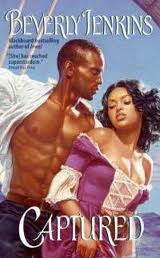
Beverly Jenkins's Captured is the first I've read by her, and I was intrigued by the new worlds she explores. Specifically, the New World - America, and not just Boston and New York. Her main character, Clare, is a slave, and is captured by the pirate Dominic, who takes her to his Caribbean island of freedmen, and hopes to keep her there. However, Clare's children are still enslaved up in Georgia. So despite her growing love for Dom - and his for her - she refuses to stay in paradise with him. Dominic is another rake who has to mend his ways to become a one-woman man, and there's some guff with his white half-brother and a slaver who is out to get him, but Clare is enchanting and worth all the trouble he and his loyal men must take to rescue the kids and ensure her happiness. Now, the writing in this was very clunky at the start, and never entirely effortless, but Jenkins still created a believable and intriguing world and characters worth cheering for. And as I said, the change of venue from London ballrooms was a lot of fun for fans of historical romance.

Wednesday, January 18, 2012

Gettin' Contemporary with the Romance

(Yeah, I don't know what that means. But, hey, it could sound raunchy, if you tried.)

So, I've discovered something about myself as a writer. To wit: if I want to actually do any writing, I have to not read anything by Kristan Higgins. She makes me throw in the towel. Her books are funny, and fun without being zany, and sweet. Her characters are real, and smart, and deserving of love. She makes me cry. A lot. So whenever I finish one of her romances, I sink into a depressive state, because why bother writing when she already has it under control? Foolishly, though, I read Until There Was You this week. Many tissues - many, many tissues - later, and I am happy to recommend anything by Higgins. At least I can rest easy knowing I only have one more of her novels to pick up before I've devoured everything she's ever published. That'll be a relief; I'll pencil in drafting the rest of my novel for a couple of weeks after I've finished that. (Kristan Higgins, if you're reading this, please don't publish anything new for a few months. Thanks.)

Another who makes me giggle is Jill Shalvis - I read my first (and second) by her this month, and anticipate ending 2012 with her name prominent on my Books Read spreadsheet. Based on The Trouble with Paradise and Instant Attraction, Shalvis makes frequent use of the zany / escapist fantasy tropes so common in romance novels. So, sure, I suspend disbelief a little to imagine being a cashier suddenly on a cruise in the South Pacific, surrounded by gorgeous, rich men. But if the dark brooding doctor with the French accent wants to irritate me and rile me up, I'll know that we're destined to be together, so that's nice. Shalvis has a very crisp writing style, sharp and light at the same time, and while hardly creditable, her characters are still believable and I enjoy their journeys to happily ever after moments.

The Rose Garden by Susanna Kearsley isn't strictly contemporary, what with the time travel and all, but much of it is set in modern Cornwall (a region I've encountered fictionally more and more lately. Cornwall is the new New England, I suppose.) I simply gobbled up Kearsley's first novel, The Winter Sea, and was hoping this would be as enchanting. It's not, quite, though it has many of the same elements: a woman searching for a place of her own, a man out of time, Jacobite plotters, and deft handling of the modern woman who finds herself in another century, I can almost hear Kearsley saying, "Why would this woman who suddenly time jumps back and forth NOT do X, Y, and Z when she was back in her own century?" and then creating a protagonist who applies logic to her freaky confusing situation. It's refreshing. (Yes, there are that many books with time travel, and yes, the modern people going back do show a surprising reluctance to Google about it.)